Mary Hare School - the National Grammar School for the Deaf
Per oculus et aures
Per oculus et aures
The Mary Hare School is the designated national grammar school for British deaf children aged 11-19. It was founded on January 1, 1946 following the bequest of Mary Hare's beloved Dene Hollow Oral School in Burgess Hill, Sussex which had run from 1916 to 1944. The grammar school opened its doors to 47 pupils on April 30, 1946 and in 1949 it moved to its present premises at Arlington Manor, three miles north of Newbury, Berkshire.
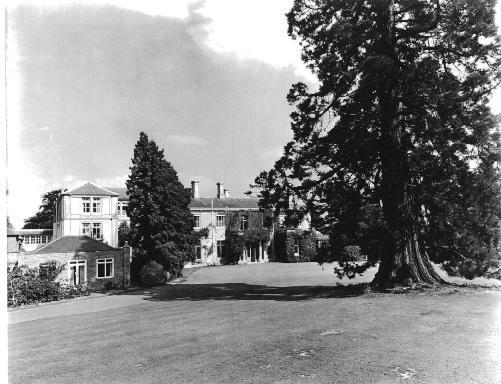
Arlington Manor, Newbury. Photo taken by Andrew
Saks.
Before 1945, a mere six deaf people were thought to have graduated from universities in the British Isles. This select group, however, did not include the legendary Abraham Farrar who was a pupil of Reverend Thomas Arnold, the founder of Spring Hill School for Deaf Boys in Northampton ("The Arnold Way", AJ Boyce, 2009). Farrar was, in fact, the first deaf Englishman to be matriculated (i.e. admitted) to a University (London in this case) but he decided to pursue a career in law (J. Branson and D. Miller, Bulletin of the John Rylands Library, Vol. 80, No. 1, p. 173-196, 1998). Spring Hill alumni include Bernard L. Pitcher who in 1939 became the first congenitally deaf person in the United Kingdom to get a PhD (Geology, Imperial College, University of London) and the famous poet David Wright whose widely acclaimed autobiography, Deafness, describes his experiences at Spring Hill and subsequently at Oxford University in the late 30s; the book has been translated into several languages (in 1990, I saw a copy of the Dutch translation in a secondhand bookstore in Leiden).
As is wont with history, the number of six should now be revised to include at least three more people. Ellis Llwyd Jones matriculated at Oxford around the start of the First World War (Ewing, Brit. J. Educ. Studies, 4, 103-128). Unfortunately he did not complete his undergraduate studies. He had wanted to serve his country in the war and in 1917 died at home after falling ill working in an army canteen. His bereaved father endowed the Ellis Llywd Jones Professorship of Audiology and Deaf Education at the University of Manchester which is one of the most prestigious chairs in the field. Later, Dame Kathleen Ollerenshaw (nee Timpson) who became deaf at age 8, won an open scholarship in mathematics at Somerville College in 1931, went onto do a PhD in mathematics and became a distinguished mathematician (Ollerenshaw, To talk of many things, 2004). In many ways, she was like Charlotte Agnas Scott who was deafened in her late teens, went to Cambridge in the late 1880s, was denied a Wrangler in the Mathematical Tripos due to gender, became the first woman to chair a mathematics department (Bryn Mawr in Philadelphia) and finally was one of the co-founders of the American Mathematical Society. Finally in 1944 David Elias, one of the earliest successful examples of mainstreamed deaf children under the guidance of Professor Ewing who was the first holder of the Ellis Llwyd Jones Chair, obtained a degree in Natural Sciences at Cambridge (Emmanuel College) and after obtaining a PhD in Chemistry at University of Leeds in 1948 pursued a career in industrial chemistry; it is likely that David later crossed paths with my D.Phil. advisor!
In the April 2004 issue of the Journal of the British Deaf History Society (Vol 7 No 3), Anthony Boyce provided more information on the other four original members of the select group. From Spring Hill, Charles Mallet went up to Oxford (St John's College) and graduated with a BA in Chemistry in 1907. He was followed by Noel Brunning-Maddison who was at Imperial College from 1907 to 1910. Boyce could not confirm whether he had graduated but Silent Worker (cited in Harry Lang's monograph "Silence of the Spheres") reported the feat in 1910; also in BDHS Supplement V, John Hay cites that Spring Hill headmaster, Ince-Jones, reminded Imperial College about Brunning-Maddison when Pitcher was being considered for admission. Another Spring Hill alumnus, Charles D. Irvine, went to Edinburgh in 1907 but it was not known whether he graduated. Finally, George Mackenzie, who was unable to matriculate at Liverpool or Oxford, went to Cambridge in 1907 and graduated in 1910; Mackenzie was apparently the complete opposite of Farrar who did not involve himself in the deaf community (see also Chapter 1 of "Through Eyes not Ears" and a blog at the UCL Ear Institute & AOHL Libraries).
The 1946 intake at Mary Hare Grammar School comprised mainly of pupils from the Dene Hollow Oral School and Spring Hill School which had closed its doors for good in 1944. Incidentally, Dr. Pitcher went to Dene Hollow from age 9 to 16 and then went to Spring Hill to prepare for matriculation for the University of London. He has credited Mary Hare for laying the foundations of his education ("The Lady in Green").
The establishment of the Mary Hare Grammar School was accompanied by the 1944 Education Act which expanded provisions for education for everyone including deaf children. Local educational authorities were allowed to send deaf children to residential schools outside their catchment areas.
Since opening its doors to students with high academic calibre after an entrance examination, Mary Hare has produced the majority of deaf graduates of universities as well as 20 of 48 known deaf PhDs in Britain. The greatly expanded facilities at its Arlington Manor premises have allowed at least 2000 deaf children to fulfil their potential and move onto careers as diverse as paramedics, banking, teaching, accountancy, law, research, computers, management, music etc as evidenced by a non-scientific analysis of the careers and/or lives of alumni listed on various social media.
Under the stewardship of five principals, Edgar Mundin BA (1946-1950) who had been at Spring Hill, Raymond Askew BA (1950-1973), Kenneth Pearce MA (1973-1987), Ivan Tucker PhD (1987-2004), Tony Shaw BSc (2004-2014) and Peter Gale BA (2014-), Mary Hare has acquired a worldwide reputation in deaf education with its examination successes well above the national average. In particular, Mary Hare is the only school for the deaf in the world that offers music as an academic subject. Mary Hare has now expanded to include a primary school (previously known as Mill Hall Oral Primary School which incidentally was founded by Miss Corbishley a contemporary of Miss Mary Hare and once a teacher at Dene Hollow), an outstanding deaf education training program and a commercial venture Mary Hare Hearing Services, 50% of whose profits go back into the schools per se. The expansion resulted in Dr. Tucker becoming the Chief Executive of Mary Hare Schools in 2004; Dr. Tucker retired in 2011 after 25 years of outstanding stewardship of Mary Hare. Mr Shaw retired in 2014 after 20+ years of outstanding leadership at Mary Hare. PDF copies of inspection reports from The Office for Standards in Education, better known as Ofsted, are available online.
The first version of this webpage was created in Spring 1996 to celebrate the 50th anniversary of the foundation of Mary Hare and had two articles about Mary Hare which have now been transferred to the Mary Hare History website. The first article appeared in the 1983 edition of the Phoenix magazine of the Mary Hare Old Pupils' Association. The second article including several photographs is by Jean Saks (1933-37), a transplanted American who went to Dene Hollow Oral School. In her own words, she describes what it was like to be taught by Mary Hare.